Study: Chocolate and depression go hand in hand - CNN.com According to a study published this week in the Archives of Internal Medicine, people who feel depressed eat about 55 percent more chocolate than their non-depressed peers. And the more depressed they feel, the more chocolate they tend to eat.
Tuesday, April 27, 2010
Study: Chocolate and depression go hand in hand - CNN.com
Libertarian Party of Pennsylvania elects Executive Board
Experience, enthusiasm and principle to match growing party
Louis R. Jasikoff is self employed in the transportation and marketing fields. He has an accounting degree from Fordham University with additional training from Hofstra University. For 25 years he owned, built, and operated a restaurant and motel outside of Yellowstone Park in Montana with his wife and his two children. He has 3 grandchildren. He has served as Chair for the New Jersey Libertarian Party, run for U.S. Congress in New Jersey, and currently serves as Chair for the Northeast Libertarian Party. He resides in Factoryville. Pa.
Jim Fryman is a retired real estate appraiser and negotiator and he and his wife Patti live in Venango County. He is a Graduate of Clarion University (BS Education) and has additional training at Univ. of West Florida and Penn State University. He served in the US Navy as an electronics technician and is an elected township auditor. He is active in Oil Region Toastmasters and Catholic War Veterans and has two children and two grandchildren.
Kat Valleley and her husband, Tim, recently moved back to her hometown of Chalfont in Bucks County. She has been homeschooling their three children for the past 8 years and plans to do so through their high school years. When not busy with household or politics she enjoys reading, singing, cooking and baking and video games. Kat is also the Treasurer of the Montgomery County Libertarian Committee.
“With our new Board in place, we are looking forward to the continued growth of the Libertarian Party in Pennsylvania, indicated Mr. Robertson, “and will renew our efforts to restore individual liberty and limited, efficient government in our commonwealth.”
The Libertarian Party is the third largest political party in Pennsylvania and the United States. More than 200,000 people across the country are registered Libertarians, and Libertarians serve in hundreds of elected offices. Please visit www.LP.org or www.LPPA.org for more information.
Libertarian Party of PennsylvaniaMalvern, PA – The Libertarian Party of Pennsylvania (LPPa) elected a new Executive Board at their annual convention in April. Elected to the Board were
3915 Union Deposit Road #223
Harrisburg, PA 17109
www.lppa.org
For Immediate Release: April 26, 2010
Contact: Doug Leard (Media Relations) at Media-Relations@lppa.org or
Michael Robertson (Chair) at 1-800-R-RIGHTS / chair@lppa.org
• State Chair: Michael RobertsonMichael J. "Mik" Robertson is a geologist and a township supervisor. He and his wife Maggie along with three-year old daughter Claire have a farm in Clarion County where they raise certified naturally grown produce. Mik is vice-president of the Clarion County Association of Township Officials. He formerly served on the multi-municipal planning committee which prepared a comprehensive plan for the future of their township and adjacent borough. He is Vice-Chair of the Libertarian Party of Clarion County.
• Eastern Vice-Chair: Louis Jasikoff
• Western Vice-Chair: Jim Fryman
• Treasurer: Kat Valleley
Louis R. Jasikoff is self employed in the transportation and marketing fields. He has an accounting degree from Fordham University with additional training from Hofstra University. For 25 years he owned, built, and operated a restaurant and motel outside of Yellowstone Park in Montana with his wife and his two children. He has 3 grandchildren. He has served as Chair for the New Jersey Libertarian Party, run for U.S. Congress in New Jersey, and currently serves as Chair for the Northeast Libertarian Party. He resides in Factoryville. Pa.
Jim Fryman is a retired real estate appraiser and negotiator and he and his wife Patti live in Venango County. He is a Graduate of Clarion University (BS Education) and has additional training at Univ. of West Florida and Penn State University. He served in the US Navy as an electronics technician and is an elected township auditor. He is active in Oil Region Toastmasters and Catholic War Veterans and has two children and two grandchildren.
Kat Valleley and her husband, Tim, recently moved back to her hometown of Chalfont in Bucks County. She has been homeschooling their three children for the past 8 years and plans to do so through their high school years. When not busy with household or politics she enjoys reading, singing, cooking and baking and video games. Kat is also the Treasurer of the Montgomery County Libertarian Committee.
“With our new Board in place, we are looking forward to the continued growth of the Libertarian Party in Pennsylvania, indicated Mr. Robertson, “and will renew our efforts to restore individual liberty and limited, efficient government in our commonwealth.”
The Libertarian Party is the third largest political party in Pennsylvania and the United States. More than 200,000 people across the country are registered Libertarians, and Libertarians serve in hundreds of elected offices. Please visit www.LP.org or www.LPPA.org for more information.
Letter to the Hagerstown Herald-Mail: Tea Party, Think again.
Dear Editor,
With regard to the Tea Parties, I'm glad that people are at least finally beginning to take an interest in their own governance. After decades of indefensible apathy, it's a start. Despite the consistent misrepresentations of the mainstream media, however, the Tea Parties did not originate in 2008 as a response to banker bailouts or the election of a so-called "socialist" president. The movement was born in 2007 to organize independent protests against taxation without representation. Only in the last year or so has it been hijacked by corporate PACs and "anti-Big Government" Republican hypocrites. Having fallen under the spell of these manipulative forces, the Tea Parties have already lost sight of their real enemy.
While there's been no essential change in my positions, I too was guilty of some flawed semantics when railing against Big Government in my blog. It wasn't because I thought there was anything inherently wrong with government, but because our current system of ever-expanding government is a creation and wholly-owned subsidiary of Big Corporations, most of which are transnational and have no interest in what's good for America. Lately, though, I've been coming to the surprising realization that, while the Feds are definitely "Big," they cannot be correctly defined as "Government." I'm reaching the rather ironic conclusion that I'm not so much opposed to Big Government as I am to the fact that Americans have no real government at all.
In an age in which drug addicts spend half their lives behind bars, but Wall Street CEOs get away with grand larceny and presidents get away with treason and murder, how can it be said that we live under any kind of government, big or small? Americans are not living in an era of Big Government, but rather in an era of orchestrated anarchism in which our corporate-owned "leaders" ignore the Constitution whenever it's convenient, and only enforce our laws against those who have no effective means of defending themselves. I wouldn't want to discourage Tea Partiers from voicing their opinions, but I do hope that they will 1.) return to their independent roots and 2.) wake up to who the real enemy is--not the puppets in the White House and Congress, but rather the global bankers and war industry executives who pull their strings.
Regan Straley
http://libyahill.blogspot.com/
Monday, April 26, 2010
Chatham University WATER POLO season ends with great results.
Athletics News Chatham University Chatham finished their season this year with an overall record of 4-18 in competition. “I am extremely proud of the way that these young women competed, not only this weekend, but all season long. They worked hard and never quit,” says head coach Mike Meyers.Yes!
What to do with the PPS City League Sports -- District VIII and joining the WPIAL, District VII
A great post, from another blog from Pierre R. Wheaton. Read it here or there and reply on his blog, not mine.
What to do with the Pittsburgh City League?Tuesday, April 20, 2010
As most of the teeming masses that read this blog know, I'm a fan of high school sports. I help moderate the PA Sportsboard on teh interwebs which deals heavily in local, statewide and national high school sports. On that board, my handle is City League Advocate. I chose that name because of my love for a particular brand of high school sports. And that is the league that includes the nine public high schools in the City of Pittsburgh that are part of the Pittsburgh Public Schools (PPS).
This league is commonly known as the Pittsburgh City League or PIAA District 8.
Background info: I'm a City League guy. Born and raised and still live in the City of Pittsburgh. Attended PPS schools from K-12. Contrary to popular belief, I strongly believe that a quality education can be found in the Pittsburgh Public Schools, if one is willing to put in the time, legwork and dedication necessary to make it happen. The tools are there, you just have to pick them up and use them.
The City League goes back to the turn of the 20th century. And over time it has produced many great athletes that have gone on to have outstanding pro careers. One only has to mention the legendary Westinghouse Bulldog football teams under Pete D'Imperio and George Webb that ruled not only the City League in the 50's, 60's, and '70's but also proved to hold their own against the best of the WPIAL and even statewide. The Perry Commodore teams of the early 2000's that made its mark on the local high school football scene. And who could forget the 1988 Commodores that won the City League's only state title in football. The great Schenley Spartan basketball teams that won state titles in the '60s and '70s with such headliners like Maurice Lucas, Kenny Durrett, and Robert "Jeep" Kelly, and even today with San Antonio Spurs rookie DaJuan Blair. The City League has produced great athletes as well as great human beings that excelled both in and out of the classroom as well as in life.
But these days, the City League isn't what it used to be. The reasons are many and varied. The ongoing flight to the suburbs that started in the 50's as well as the collapse of the steel industry in the 70's and '80s, among other factors caused many families to move out of the city decreasing the enrollment of Pittsburgh Public Schools from a high of over 50,000 students in the '70s to its current number of approx 26,000. That had an effect of cutting tax revenues that could be used for facility maintenance and equipment purchases as well as shrinking the talent pool for athletics.
And because the majority of the high schools were built over 80 years ago, they were landlocked in tightly confined neighborhoods with little room for expansion. To this day there are schools in the Pgh. City League that do not have an athletic field on campus. Only one high school was built in the last 35 years, Brashear, which was completed in 1975. As a result, most City high schools lag far behind their suburban counterparts in terms of facilities and athletic amenities. If you go to a typical suburban Western PA high school which was built in the last 50 years, you'd see a large wide-open campus built back in the days when land in the suburbs was cheap and plentiful and the planners accounted for the inevitable need for expansion. Many of today's biggest campuses rival some small colleges in terms of their physical plant. Having such luxurious amenities also contributes to the number of reasons many families who are coming into the Pittsburgh area and are looking for a place to buy a home often prefer the suburbs to the city. That and also the perception of a better education, a safer learning environment, better coaching and also the benefits of living in a smaller tighter knit community.
As a result of all these factors, the Pittsburgh City League lags behind the WPIAL in terms of overall success on the athletic field. Now before I go further, let's take a little time out to educate you, the reader on how high school athletics works in Southwestern Pennsylvania.
High school athletics are governed in Pennsylvania by the Pennsylvania Intercollegiate Athletic Association or PIAA. This body sponsors state-wide championships in 20 boys and girls sports. It also sets the standard rules of conduct for players, coaches, staff and fans. It also licenses referees and event officials and insures that the rules of competition laid down by national and local governing high school sports bodies are followed. All participating high schools (membership in the PIAA is not mandatory) are divided by location into 12 districts. For this essay's sake we are concerned with only two. District 7 and District 8. District 7 covers nine counties in Southwestern PA as well as all private and parochial schools in the City of Pittsburgh. District 7 is governed by the Western Pennsylvania Interscholastic Athletic League or WPIAL.
There are approximately 130 school districts that are members of the WPIAL. It is the largest athletic league in Pennsylvania as well as one of the largest in the country.
District 8 covers the public schools of the Pittsburgh Public School district. It is the smallest PIAA district in the state and one of only two districts in which all the schools are members of only one school district, the other being District 12 which covers Philadelphia. In terms of relationships between District 7 and District 8, please check this map. District 7 surrounds District 8 on all sides.
Now back to the essay. With very few exceptions, most City League schools do not fare well against WPIAL schools in most sports. The most glaring examples of the disparity between the two leagues are in football and the so-called "olympic" sports (tennis, swimming, golf, soccer, hockey, etc.) In football, the best City League school would most likely end up in the middle of the pack of their equivalent enrollment class in the WPIAL.
An example. The Schenley Spartans, last season's City League championship football team in the PIAA Class AAA, go manhandled in the first round of the AAA playoffs losing by 32 points to Erie Cathedral Prep 44-12. In baseball, the AAAA City League champion, Allderdice, who had won most of their games against City League opponents by double digits, and had a number of games ended prematurely by the ten run rule was beaten by Pine-Richland of the WPIAL 9-0 in the first round of the 2009-10 state playoffs. Perry, the 2009-10 City League wrestling champion, did not score a point in an 84-0 drubbing by the #2 seed in the WPIAL, Kiski Area.
It is rare for a City League team in any sport to make it past the first round of state playoff competition, much less make the result respectable. Even the disparity between schools within the City League is just as disturbing. The larger more affluent schools like Allderdice, Brashear, and Carrick are more equipped to compete against WPIAL schools. Schools like Langley, Peabody, Oliver, and Westinghouse would be hard pressed to compete at best against the middle to lower half of WPIAL schools and often forfeit games against City teams.
Using my alma mater as an example. Allderdice is not a traditional football power in the City League and has only won a handful of games against WPIAL schools. They have fared better in basketball. But in sports like tennis, soccer, swimming, baseball and others, Allderdice can compete on a more or less equal basis against some of the better schools in the WPIAL. On the whole, in most sports, Allderdice would fare in the middle to upper half of the WPIAL. Brashear would be a solid middle of the pack contender overall as would Carrick.
Other than a lack of quality facilities and coaching, the City League also suffers from a discernable lack of community support. One advantage that schools in the WPIAL have is that they enjoy support in their communities that City League schools could only dream about. One reason for that is that with the public school districts of the WPIAL, those districts have a few elementary schools, a couple middle schools and with very few exceptions, one high school that serves a particular community or in some cases, a small number of communities. The local high school has the total support of the community that it serves. In those small towns and municipalities, the high school is the major local source of community pride and identity. Go into any suburb around Pittsburgh and you'll see much evidence of support of the local high school teams especially if that school's teams are in the playoff hunt. These communities rally around their local high schools and they know that the kids that represent that school come from that community and are "home-grown."
The City League does not have that support in abundance. There are nine high schools in the Pittsburgh City League and while the neighborhoods those schools serve may support the athletics of the local school, they do not do so to the extent of the schools in suburban districts. A lot of that can be attributed to the fact that compared to a city the size of Pittsburgh that has many other activities that compete for the scarce time and resources of high school students, smaller suburban communities tend to have fewer impediments that compete with the local high school as the center of local youth activity. The existence of booster clubs run by parents that support various sports at the high school also plays a significant part.
Also, with the ability of kids to essentially attend any school in the district regardless of that school's location, the sense that the kids are home-gr0wn and part of that local neighborhood is diluted. This happened because of the creation of the city-wide magnet schools that concentrated on a specific theme or course of study rather than a specfic location. these schools were created in order to comply with the desegregation order that was placed against the Pittsburgh Public Schools in 1989 by the PA Human Relations Commission.
It is questionable as to whether the order actually succeeded in desegregating the schools because there are still at least three high schools in the PPS that are in excess of 80% African-American population. But the creation of those magnet schools did allow kids from anywhere in the city to attend them rather than be forced to attend the local high school in their community. The magnet programs have been largely successful in the educational sense, but in the athletic sense have hurt the City League because some students may transfer out of their neighborhood schools to a magnet school primarily to play on a better football or basketball program. There were numerous accusations that Perry Traditional Academy on the North Side had used this approach to lure top athletes from other city schools to play for its football and basketball teams. And during the late'90s and early 2000's those accusations had a tinge of merit as Perry dominated both football and basketball during those times. But the effect has since worn off as Perry has not won a City football title in the last 4 years and has only won one basketball title 3 times since 2002. Although Schenley winning 4 straight basketball titles between 2004-2008 might also appear to add some truth to this premise because Schenley is a magnet school, but it must be said that the Spartans won using mostly local talent from North Oakland and the Hill.
But the magnet schools seem to have taken away the attitude that many of a schools athletes playing in the so-called marquee sports of football and basketball are representative of the neighborhood where the school is located.
Also at least in football, the centralizing of all football games at one stadium has negatively affected the level of community support for City League athletics. In most suburban districts, the students, alumni and staff of that school district go out of their way to maximize their home field advantage. Go to a game at Aliquippa's "Pit" or Woodland Hills "Wolvarena" and there is no doubt where you are and who plays at that stadium. The local community knows that stadium is their baby and they get behind their team with great passion. You'll see signs and posters in the school's colors. The myriad of traditions and pageantry that makes high school football what it is in this region.
The City League, by having all their games played at one location eliminates that "home field advantage." To be sure, the reason for the move was a practical and necessary one. Only 5 of the current city high schools have on-campus or near-campus athletic fields, and in most of those cases, the fields were well short of the state and national requirements for safe play and a decent viewing atmosphere. Some of those fields didn't even get grass on them until the late '80s. Also in the era of games played on campus fields, only the home team's fans could go to the games due to incidents involving fights between opposing school's fans. And each field had its own security issues and plans of ingress and egress in case of emergency, so in the early 90's it was decided to have all football games played at Cupples Stadium on the South Side. The advantages were that Cupples was the best maintained stadium in the city having been the second stadium in the Pittsburgh area to receive artificial turf back in the mid 70's. Cupples was also centrally located, had easy to control ingress and egress and was able to accommodate fans from both schools with a minimum of incidents. And because the field was artificial turf, maintenance costs were lower.
But the negatives are that there is no true "home field" advantage. The only advantage that the home team gets at Cupples is that their fans get to sit on the side of the field with the press box and their band performs at halftime. The midfield decoration is a generic 'Pittsburgh Public Schools' logo. The cheerleaders will hang signs on their side of the field in the colors of the school urging theor team on, but the effect is not the same. Crowds at City League football games can range from less than a hundred in the case of two bottom place teams playing to over a thousand if two good teams are playing or if it's the championship game. If Perry and Brashear are playing for the overall lead in the league and both teams are good, Cupples jumps as much as any high school stadium in the region. But put two teams like Langley and Westinghouse who are winless and no chance at the playoffs and just playing out the string, you might see more people on the field than in the stands.
You go to most City League football games and there's no life and little excitement. The crowds are sparse, in some cases, it seems like even the players don't want to be there. The stadium is largely empty, I've been to games where not even the home team's band bothered to show up much less played at halftime. Someone described the typical City League football game as like watching two prison teams playing. There are those who call for returning the City League games back to the neighborhoods, but that won't happen unless the PPS is willing to invest millions of dollars that it doesn't have in renovating the current campus fields to the point where they could be comparable to even a modest stadium in the WPIAL.
Because all nine teams have to share the stadium, that makes for games being played at non traditional times. Currently, the City League plays games at 7pm on Thursdays, 3:30pm and 7:30pm on Fridays and either 11:00am, 1:00pm, 3:oopm, or 5:00pm on Saturdays depending on the schedule. In most WPIAL schools and also in the majority of the state, high school football is played at 7:30pm on Friday nights, except for those few stadiums that don't have lights and their games are played on Saturday afternoons. In the WPIAL, there are a few Thursday night games mostly to accommodate local cable television, but in Pennsylvania, 7:30pm Friday night is the traditional time for high school football.
The effect of having multiple times for playing games tends to play havoc with City League teams and fans. Most parents can't always make the 3:30pm Friday games and the students are just getting out of school an hour before and can't or won't travel the distance to the South Side to take in the game. The 7:30 Friday night games get the best crowds, but even that depends on the two teams playing, and often the schedule makers will put the two worst teams in that prime spot. The numerous different playing times also cause headaches for the coaching staffs in preparing for the upcoming games. In the WPIAL, teams know that, by and large they will be playing at 7:30 on Friday night. The coaching staffs have their practice and game preparation routines laid out to that time. In the City League, teams can have anywhere between five and nine days between games to prepare and practice. It is not uncommon for a team that played on noon Saturday to turn around and be ready to play again the following Thursday. Conversely, a team that played Thursday can be scheduled to play again the following Saturday week. And because there are an odd number of teams playing in the league, the bye week adds an extra seven days leaving some teams with up to 16 days between games, if they didn't schedule a non league opponent. City League coaches and players take it all in stride because they know that is the way it is in this league.
I could go into a lot more stuff that causes those from outside the City to wonder how this crazy quilt system works in spite of every logical conclusion that it shouldn't, but I have to close this piece as it's getting very long.
The question is now, what is the future of the City League? The answer is...who knows? The PPS school board and superintendent are working on reforming the high schools of the district to maximize efficiency and to cut down on the excess capacity that exists in the district's buildings. Schenley High School will be no more at the end of the 2010-11 school year. There is talk of closing Peabody and merging their students with Westinghouse, which should be interesting given the long time rivalry between the two schools. There is also talk of possibly closing Langley and/or Oliver.
There are to be more magnet and specialty high schools coming on line. Too many to cover in this piece. I'd suggest going to the Pittsburgh Public Schools website and rooting around there for the details. But it seems to me that while the board is restructuring the schools for educational purposes primarily, the question is, how will this affect the City League? Does the board even care? I'm of the opinion that the PPS board tends to put athletics on the back burner in terms of priorities. They're more interested in doing what it is they do and leaving the athletics to the Athletic Director. There are many questions to be asked. How will the upcoming specialty high schools be dealt with in terms of athletics? Will they sponsor their own teams or have co-op arrangements with existing high schools? What high schools are next on the chopping block? It's not a question of when, but what. How many high schools will the new PPS and City League have left? And can the result continue to be a viable PIAA district and if not, will the PIAA say something?
One premise that has been floated on occasion, but has never received much traction is the merging of the City League into the WPIAL. There has been talk going back at least 10 years about the City League and the WPIAL coming together and so far it has just been that...talk.
The road to a merger would take several steps. First the City League would have to come to a consensus that it wants and needs a merger. Then they'd have to approach the WPIAL and petition them for membership. The WPIAL would then have to vote on accepting the City League and then petition the PIAA to allow the merger. If all of that is approved, the City League and all its traditions would then be swallowed up by the WPIAL akin to a minnow being swallowed up by a whale. It is also possible that the PIAA might tell the City League that an eight school district is too small to be viable under the PIAA district structure and might put pressure on the league to merge with the WPIAL. At this point, there isn't much interest on either side to engage in serious merger talks. In fact the Executive Director of the WPIAL, Tim O'Malley told the City League Athletic Director, Michael Gavlik that he should fight any attempt by the PIAA to phase out the City League and merge them into the WPIAL. In this article in the Post-Gazette, He maintains that with few exceptions, the City League would not be able to compete equitably with the WPIAL in most sports. In the current climate, he would be right. But as the PPS continues with its plan to close and consolidate high schools, the choice of whether to merge may not be made by the City League or the WPIAL, but by the PIAA.
Initially, any merger between the City League and WPIAL would be to the WPIAL's benefit. They would have the entire Southwestern Pennsylvania region including the City of Pittsburgh under their thumb. The disparity between the City and WPIAL schools would pretty much give WPIAL schools more or less easy wins in most sports until the City schools catch up. And they will be forced to catch up, otherwise they will be an even bigger embarrassment than they already are. The disparity between the City League and the WPIAL in most high school sports has never been wider. On the City side, a City-WPIAL merger would benefit the larger schools like Allderdice, Brashear and Carrick because they are the most "WPIAL-like" schools in the City in terms of the number of sports sponsored, and the level of success those schools have had against WPIAL competition. They would stand the best chance of having immediate success in the "olympic" sports as well as basketball. Football, however is a very different story because the disparity between the WPIAL and the City League is greatest there. It would take at least five years before the best of the City League would be able to hold its own against the best of the WPIAL on the gridiron. Schools like Allderdice, Brashear, and Carrick already schedule numerous WPIAL teams in the sports they are strong in because the compeition in the City League is just not up to standard. So it stands to reason that those schools would be able to have immediate success. The smaller City schools probably would have a tougher road to hoe.
For the record, I happen to support the merger of the City League into the WPIAL. While there will a period of adjustment when City League schools will face a very difficult learning curve in adapting to the higher level of competition as well as playing in front of audiences that are much more used to the concept of "home field" advantage, as the old saying goes, "Competition improves the breed." Or as Ric Flair says it "To be the man, you've got to beat the man. Woooo!!" It has to be done either way, better to get it out of the way now.
I feel that the PPS board will have to face this matter sooner than later because the pressure to merge could very much come from the PIAA who feels that an eight school district is too small to maintain. I would like to see the City League remain in some kind of tipoff or holiday tournament structure especially in basketball, because even though they would be part of the WPIAL, they are city schools at heart and those rivalries and traditions don't deserve to be flushed away. I don't know how it can be done, but I want to see something that allows the City schools to retain their common identity and traditions. There's too much history that would be lost and I don't trust the WPIAL to respect those traditions and memories that have been forged over the years in the City League.
But I do not want to see the City League ghettoized into some kind of City Conference that is part of the WPIAL but consists of City League schools, because all that does is repeat the problems the City League is presently facing but instead of being part of its own playoffs as it is now, they'd be part of the WPIAL playoffs. It's much better for the City schools post-merger if they were placed in their respective enrollment class and in geographically based conferences with other WPIAL schools in their location. Now that does produce some scary situations. For example, in football Allderdice, who is classified in the PIAA as a Class AAAA school, if it were merged into the WPIAL and placed into a conference that is geographically based would be in the same conferences as such traditional powerhouses as: Penn Hills; Central Catholic; and Woodland Hills.
Most of those games would be painful to watch, but if Allderdice wants to get better and compete, they will have to do what is necessary in terms of coaching, training and getting quality players out for football in order to be respectable. Brashear would be placed in a conference with Mt. Lebanon, Upper St. Clair, and Canon McMillan. No doubt that the first years would be very tough to stomach, but I think that most City League teams would be up for the challenge and would make the upgrades needed to compete respectably in the WPIAL. The exposure to real home field advantages would compel the student bodies of City League schools to raise their game to avoid embarrassment.
So what is the future of the City League? I think that the question of a merger is not whether it will happen but when. If you put a gun to my head and made me predict when a merger will go down, I'd say within the next five to seven years, the City League will merge with the WPIAL not necessarily because it wants to, but because it cannot afford not to.
Posted by Pierre R. Wheaton at 12:03 PM


Sweatshop Workers Speak Out" in Pittsburgh, PA on April 27th @ 1:30pm City Council, 7pm August Wilson Center
Join us for the "Sweatshop Workers Speak Out" Speaking Tour
Featuring a Bangladeshi garment worker who sews uniforms and a representative of home based workers in Pakistan who stitch soccer balls, the tour aims to build solidarity between U.S. communities and workers that produce for our government. Each tour event will focus on action steps that are relevant for local sweatfree organizing, whether to help ignite a new campaign or bring an active campaign to the next level.
More info about the speakers and events is below and online at http://www.laborrights.org/events/sweatshop-workers-speak-out-speaking-tour.
April 27: Pittsburgh
Garment Workers Spotlight Sweatshop Working Conditions in Factories Sewing Pirates’ Apparel: 1:30pm Pittsburgh City Council Chambers, 5th Fl. City County Building
August Wilson Center at 7pm
980 Liberty Avenue, Pittsburgh, Pennsylvania 15222
Contact: Kenneth Miller, nosweatshopsbucco@yahoo.com, 412-867-9213
Sponsored by: Pittsburgh Anti-Sweatshop Community Alliance, Pittsburgh IWW, Black Political Empowerment Project, State Senator Jim Ferlo, William Robinson Consulting, Coalition of Black Trade Unionists, National Labor Committee, Western PA Jobs with Justice, Freedom Unlimited, Steel Valley Printers/USW Local 3403
Kalpona Akter, former child factory worker, from Bangladesh Center for Worker Solidarity which was established in 2000 by garment workers and other workers struggling for their rights. The Bangladesh Center for Worker Solidarity (BCWS) is a non-profit, non-political women’s organization that works for the empowerment of working women, the rights of children, and the security of working families and communities. BCWS promotes workers’ negotiating power, gender equity, and social justice for the working class.
Zehra Bano is the General Secretary of the Home-Based Women Workers Federation of Pakistan. Zehra has been an outspoken leader in the fight for recognition of workers’ rights for women in Pakistan. She is in her mid-30s and has developed various training modules. Zehra has intimate knowledge of the plight of soccer ball workers especially related to home-based and stitching center workers.
-----------------------
Check out the 2009 Sweatshop Hall of Shame!
Trina Tocco
Deputy Director
International Labor Rights Forum
Office: 202-347-4100 x103
Cell: 269-873-1000
Skype: trinatocco
trina.tocco@ilrf.org
Featuring a Bangladeshi garment worker who sews uniforms and a representative of home based workers in Pakistan who stitch soccer balls, the tour aims to build solidarity between U.S. communities and workers that produce for our government. Each tour event will focus on action steps that are relevant for local sweatfree organizing, whether to help ignite a new campaign or bring an active campaign to the next level.
More info about the speakers and events is below and online at http://www.laborrights.org/events/sweatshop-workers-speak-out-speaking-tour.
April 27: Pittsburgh
Garment Workers Spotlight Sweatshop Working Conditions in Factories Sewing Pirates’ Apparel: 1:30pm Pittsburgh City Council Chambers, 5th Fl. City County Building
August Wilson Center at 7pm
980 Liberty Avenue, Pittsburgh, Pennsylvania 15222
Contact: Kenneth Miller, nosweatshopsbucco@yahoo.com, 412-867-9213
Sponsored by: Pittsburgh Anti-Sweatshop Community Alliance, Pittsburgh IWW, Black Political Empowerment Project, State Senator Jim Ferlo, William Robinson Consulting, Coalition of Black Trade Unionists, National Labor Committee, Western PA Jobs with Justice, Freedom Unlimited, Steel Valley Printers/USW Local 3403
Kalpona Akter, former child factory worker, from Bangladesh Center for Worker Solidarity which was established in 2000 by garment workers and other workers struggling for their rights. The Bangladesh Center for Worker Solidarity (BCWS) is a non-profit, non-political women’s organization that works for the empowerment of working women, the rights of children, and the security of working families and communities. BCWS promotes workers’ negotiating power, gender equity, and social justice for the working class.
Zehra Bano is the General Secretary of the Home-Based Women Workers Federation of Pakistan. Zehra has been an outspoken leader in the fight for recognition of workers’ rights for women in Pakistan. She is in her mid-30s and has developed various training modules. Zehra has intimate knowledge of the plight of soccer ball workers especially related to home-based and stitching center workers.
-----------------------
Check out the 2009 Sweatshop Hall of Shame!
Trina Tocco
Deputy Director
International Labor Rights Forum
Office: 202-347-4100 x103
Cell: 269-873-1000
Skype: trinatocco
trina.tocco@ilrf.org
Congressman Ron Paul - Socialism vs Corporatism - Texas Straight Talk
Congressman Ron Paul - Socialism vs Corporatism - Texas Straight Talk: "Socialism vs Corporatism
Lately many have characterized this administration as socialist, or having strong socialist leanings. I differ with this characterization. This is not to say Mr. Obama believes in free-markets by any means. On the contrary, he has done and said much that demonstrates his fundamental misunderstanding and hostility towards the truly free market. But a closer, honest examination of his policies and actions in office reveals that, much like the previous administration, he is very much a corporatist. This in many ways can be more insidious and worse than being an outright socialist."
Kraus and Ads about Drinking
Bruce Kraus wants to place ads around town concerning the South Side.
Who pays? Bus companies. Grants from Feds.
That is still public money Mr. Kraus.
Here is the deal: Enforcement. Public rest rooms. Better Parking Policies.
Who pays? Bus companies. Grants from Feds.
That is still public money Mr. Kraus.
Here is the deal: Enforcement. Public rest rooms. Better Parking Policies.
Resign already
Marty Griffin of KDKA Radio is talking about candidates who should resign from office befor hitting the campaign trails. Tim Potts, a citizen advocate, got interviewed. His organization asked all six present candidate for PA Governor to resign for the rest of the election season.
Tim said on the air that there are six states that require candidates to resign before seeking other offices. Marty said he didn't know of any of those instances.
I agree that candidates need to not be standing office holders. They cheat. And, I have first hand insights and experiences of these problems.
Our Allegheny County Charter (its the Constitution of the County) was recently crafted when we went from the three commissioners to the County Executive and part-time county council. This provision was put into the County Charter to prevent these conflicts of interest.
The county charter says members of the County Council must RESIGN from their seat as soon as they are a candidate.
It doesn't happen, generally. Some do it and I have given them props for doing so in the past. But, they stretch their time on council as long as possible -- breaking the law.
Wayne Fontana, now a PA state senator, D, from the city's south neighborhood, was former member of Allegheny County Council. He didn't resign. Only one Post Gazette editiorial spoke against this and he still got the PG endorsement. Go figure. This was in 2007.
Later, in 2008, in the time of Bonusgate, Wayne Fontana would use his senate office to produce papers to challenge opposition candidate off of the ballot -- with his PA SENATE OFFICE -- an illegal act that is part of
state judge evidence. I was that independent candidate who was seeking to get onto the ballot so that voters would have a choice. I didn't want Fontana to run without any opposition.
I'd be glad to talk to anyone about this saga and offer up policies to fix these ills of our shared democracy in PA.
Update: The letter was read on the air, 11:32 am.
 Here is my story from Friday. I went to Harrisburg with the Youth & Government program, a three day confab organized by the YMCA. We had a bus load of kids from Schenley High School.
I hadn't been with some available time in Harrisburg on a work day since I was there on August 15, 2008, in court. On August 16, 2008, I was due to start a summer camp coaching gig at a swim camp in Canada. I was called to court for a petition challenge as I was seeking to get onto the ballot for PA Senate, 42nd district for the November 2008 election.
I wanted to visit the scene of the crime and see what was still part of the public record, and what was not.
When I was there in 2008, the court was in the Irvis office building. They've moved into a new building in 2009. Nice space. The lobby floor has a huge state seal, see above photo.
 The Judicial Center is on Commonwealth Ave, just a short walk from the Capital.
Go to the second floor.
 Go to the Commonwealth Court Filing Office, room 2001. Nice workers are there at a counter. Ring the bell if you must.

These records are not on the internet. But they can be viewed in that office.

This is the third document on the left that shows evidence.

Click for larger view. Cost per page in the office is $.50. I only needed one page to be printed.
What isn't part of the evidence on those computers any longer is the court transcripts. They were purged from the system in 2008. Go figure. We remember. I was "pro say." That means I was without a lawyer. Thank goodness. I had hired a lawyer at one other ballot challenge ordeal and that was a waste of money.
Fighting to stay on the ballot was a waste of money too. And, it is a great waste of freedom as well.
When the judge entered the courtroom, I didn't sit down. "Point of order, your honor." That came from me on multiple instances -- as I had nearly ten points to make before we'd get to the actual case.
I wanted to be sure that I could fight to stay on the ballot but would NOT be hit with charges from the judge in terms of a bill for court costs. That was not a promise he would make. It was bad and got worse in terms of the loss of hope and exposure I'd be faced with. In another court room, the Green Party was racking up a bill of more than $80,000 to stay on the ballot. And, he didn't succeed in getting onto the ballot. But, they had to pay that money for the hope after collecting the signatures.
I had to have 500 signatures of voters and turned in 981 signatures. They were valid. But, it would have taken days to prove them. Furthermore, I wasn't fortified with the PA Senate Office Staffers nor the Dem Party Lawyers. They were all flush with cash, bonus pay, and the judges -- all elected from one of the two old parties. The judges were not interested in any success from a third party candidate.
Summary: When anyone asks you to sign a nomination paper for a third party candidate, sign it. Go out of your way to offer up your signature. And, go out of your way to get 10 or 15 signatures for that candidate too.
This year Wayne Fontana comes up for re-election. He ran without opposition in the D-Party primary and there were none from the R party to seek that office either. So, who wants to run?
Finally, if there are candidates on the ballot without opposition in the November election -- DO NOT VOTE for them. Leave that ballot question blank. The more the votes for the winner then the more signatures the next candidate needs to obtain to get onto the ballot in the next election.
Tim said on the air that there are six states that require candidates to resign before seeking other offices. Marty said he didn't know of any of those instances.
I agree that candidates need to not be standing office holders. They cheat. And, I have first hand insights and experiences of these problems.
Our Allegheny County Charter (its the Constitution of the County) was recently crafted when we went from the three commissioners to the County Executive and part-time county council. This provision was put into the County Charter to prevent these conflicts of interest.
The county charter says members of the County Council must RESIGN from their seat as soon as they are a candidate.
It doesn't happen, generally. Some do it and I have given them props for doing so in the past. But, they stretch their time on council as long as possible -- breaking the law.
Wayne Fontana, now a PA state senator, D, from the city's south neighborhood, was former member of Allegheny County Council. He didn't resign. Only one Post Gazette editiorial spoke against this and he still got the PG endorsement. Go figure. This was in 2007.
Later, in 2008, in the time of Bonusgate, Wayne Fontana would use his senate office to produce papers to challenge opposition candidate off of the ballot -- with his PA SENATE OFFICE -- an illegal act that is part of
state judge evidence. I was that independent candidate who was seeking to get onto the ballot so that voters would have a choice. I didn't want Fontana to run without any opposition.
I'd be glad to talk to anyone about this saga and offer up policies to fix these ills of our shared democracy in PA.
Update: The letter was read on the air, 11:32 am.

I hadn't been with some available time in Harrisburg on a work day since I was there on August 15, 2008, in court. On August 16, 2008, I was due to start a summer camp coaching gig at a swim camp in Canada. I was called to court for a petition challenge as I was seeking to get onto the ballot for PA Senate, 42nd district for the November 2008 election.
I wanted to visit the scene of the crime and see what was still part of the public record, and what was not.
When I was there in 2008, the court was in the Irvis office building. They've moved into a new building in 2009. Nice space. The lobby floor has a huge state seal, see above photo.
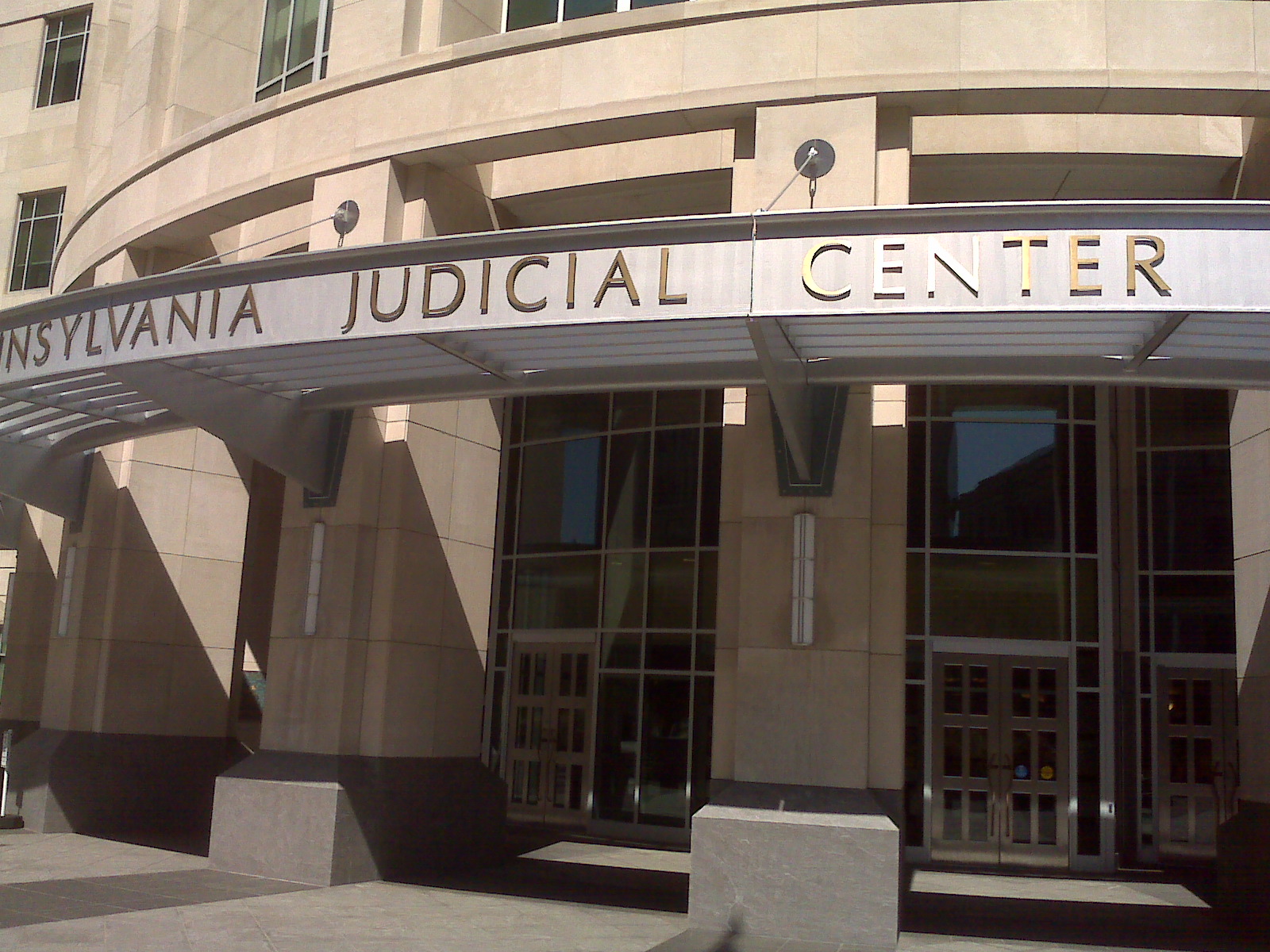
Go to the second floor.
 Go to the Commonwealth Court Filing Office, room 2001. Nice workers are there at a counter. Ring the bell if you must.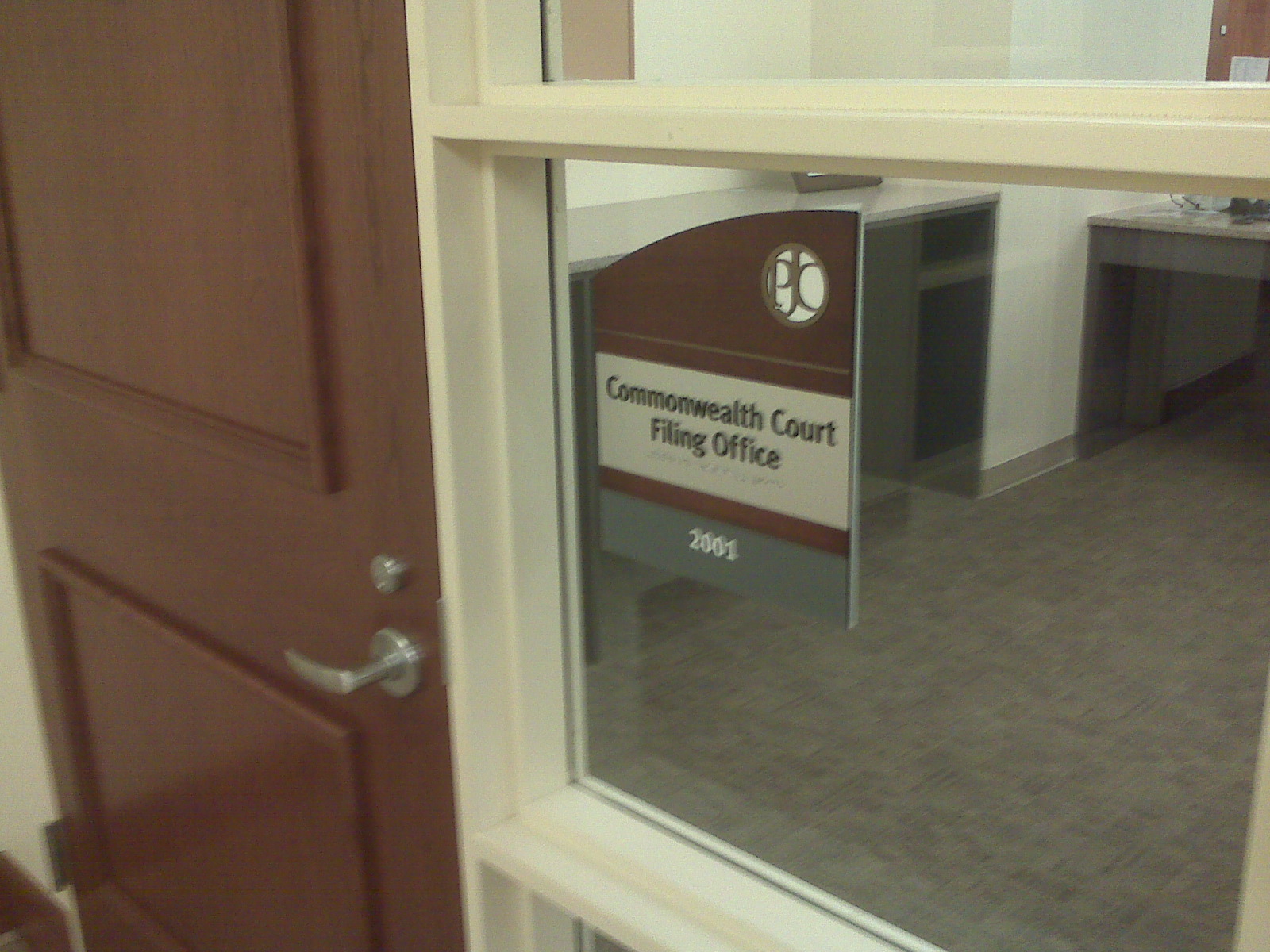
These records are not on the internet. But they can be viewed in that office.

This is the third document on the left that shows evidence.
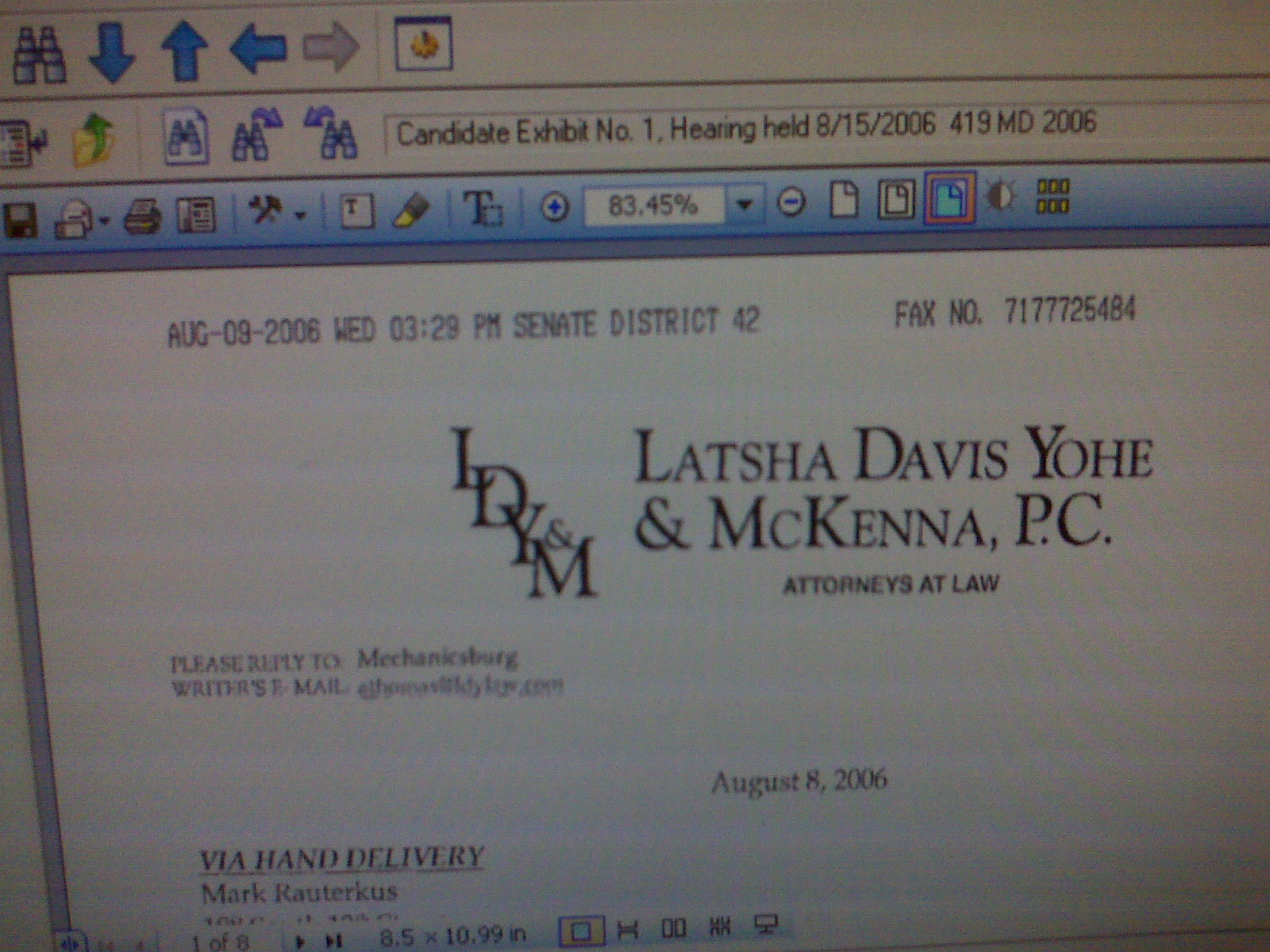
Click for larger view. Cost per page in the office is $.50. I only needed one page to be printed.
What isn't part of the evidence on those computers any longer is the court transcripts. They were purged from the system in 2008. Go figure. We remember. I was "pro say." That means I was without a lawyer. Thank goodness. I had hired a lawyer at one other ballot challenge ordeal and that was a waste of money.
Fighting to stay on the ballot was a waste of money too. And, it is a great waste of freedom as well.
When the judge entered the courtroom, I didn't sit down. "Point of order, your honor." That came from me on multiple instances -- as I had nearly ten points to make before we'd get to the actual case.
I wanted to be sure that I could fight to stay on the ballot but would NOT be hit with charges from the judge in terms of a bill for court costs. That was not a promise he would make. It was bad and got worse in terms of the loss of hope and exposure I'd be faced with. In another court room, the Green Party was racking up a bill of more than $80,000 to stay on the ballot. And, he didn't succeed in getting onto the ballot. But, they had to pay that money for the hope after collecting the signatures.
I had to have 500 signatures of voters and turned in 981 signatures. They were valid. But, it would have taken days to prove them. Furthermore, I wasn't fortified with the PA Senate Office Staffers nor the Dem Party Lawyers. They were all flush with cash, bonus pay, and the judges -- all elected from one of the two old parties. The judges were not interested in any success from a third party candidate.
Summary: When anyone asks you to sign a nomination paper for a third party candidate, sign it. Go out of your way to offer up your signature. And, go out of your way to get 10 or 15 signatures for that candidate too.
This year Wayne Fontana comes up for re-election. He ran without opposition in the D-Party primary and there were none from the R party to seek that office either. So, who wants to run?
Finally, if there are candidates on the ballot without opposition in the November election -- DO NOT VOTE for them. Leave that ballot question blank. The more the votes for the winner then the more signatures the next candidate needs to obtain to get onto the ballot in the next election.
Letters to the editor about ballot access
Letters to the editor Ballot injustices
As a member of the Libertarian Party I can relate to the revolting use of raw political power by the Democratic machine to keep Ralph Nader in 2004 and Carl Romanelli in 2006 off the ballot in Pennsylvania ('Nader vs. the System: Democracy at Stake,' April 19 column by Ruth Ann Dailey). The use of public resources is a dual crime against Pennsylvanians -- theft of tax dollars and ballot choices.
In 2008 it was the Libertarian Party facing the Republican machine. We were forced into Commonwealth Court to keep our presidential candidate, Bob Barr, on the ballot.
A Republican committeeman challenged the substitution of our presidential candidate after Mr. Barr won the nomination.
The court rejected that challenge and upheld the authority to substitute in compliance with the election code. There would have been no need to substitute if the election code did not require that our nominee submit 25,000 signatures on nomination papers while the major party nominees required none.
That signature goal changes, and recently has been more than 67,000 signatures for all statewide candidates except Democrats and Republicans. This does not appear to be in compliance with the free and equal elections clause of the Pennsylvania Constitution.
On top of that, the major party nomination process is publicly funded. The Libertarian Party nominee was selected at our own expense.
I cannot understand why it is so bad for Pennsylvania voters to have choices on the ballot when our troops are fighting overseas to put choices on the ballot for others.
MICHAEL J. ROBERTSON, Chairman
Libertarian Party of Pennsylvania
Licking Township, Clarion County
ISHOF Celebrates Black History in Aquatics
ISHOF Celebrates Black History in Aquatics: "Charles “Tuna” Chapman
First African-American to Swim across the English Channel"
First African-American to Swim across the English Channel"
Sunday, April 25, 2010
Pirates disable Jakubauskas, make roster changes
Talk about getting blasted.
Pirates disable Jakubauskas, make roster changes: "Pirates pitcher Chris Jakubauskas, who was struck behind his right ear and fell face down on the mound by a line drive, is being released from Methodist Hospital after being diagnosed with a head contusion and a concussion.Get well soon.
If Jakubauskas experiences no further trouble with the dizziness that affected him Saturday night, he may even get released by doctors to join the Pirates on their flight tonight to Milwaukee.
Open East End Panel says Site selection for Pittsburgh Obama should be reopened to consider new information. (Part 3 of many)
Background History: The DeJong consultant recommended that the IB school remain at Reizenstein rather than move to Peabody. The reasoning behind this decision is unclear. The District’s IB site selection committee made its recommendation to move the IB program to the Peabody facility almost a year prior to and without the benefit of the DeJong study. Given that the district paid $500,000 for this study the panel recommends that the district utilize it fully and explain the reasoning behind the Reizenstein recommendation.
Suggestions: In light of new information and experience, the district should bring together all interested parties including the original IB Site Selection Committee; DeJong consultants, current students, staff and administrators; and other interested citizens to determine a location for Pittsburgh Obama.
The absence of natural light at Peabody could be a factor in whether families would choose to send their children to school at the Peabody location. More than a month ago PPS Board director and OEEP member Mark Brentley submitted a request for information on the cost of adding windows to the Peabody facility but has not received this information.
(We're all still waiting.)
Any renovations that have been considered for the Obama school at Peabody and at Reizenstein and the cost of such renovations should be disclosed before a decision on the location for the school is reached.
Suggestions: In light of new information and experience, the district should bring together all interested parties including the original IB Site Selection Committee; DeJong consultants, current students, staff and administrators; and other interested citizens to determine a location for Pittsburgh Obama.
The absence of natural light at Peabody could be a factor in whether families would choose to send their children to school at the Peabody location. More than a month ago PPS Board director and OEEP member Mark Brentley submitted a request for information on the cost of adding windows to the Peabody facility but has not received this information.
(We're all still waiting.)
Any renovations that have been considered for the Obama school at Peabody and at Reizenstein and the cost of such renovations should be disclosed before a decision on the location for the school is reached.
Open East End Panel - part 5 - Where is South Vo Tech's replacement?
A career and technology center has been a long-standing and strong preference for Pittsburgh's students.
Participants in the DeJong community dialogues voiced a strong preference for a career technology center. While the district asserts that a centralized CTE site is “an ineffective delivery model,” the Parkway West Career & Technology Center offers an impressive range of CTE for 600 students from 12 suburban communities at a single center.
Training includes:
Regarding Westinghouse, the district observes in its materials that the school is in a “difficult” location. To address this issue, we recommend that a shuttle run frequently between the East Busway and Westinghouse. A model might be the shuttle that runs from the T station to Brashear. With safe transportation, a center devoted to high quality career technology could be expected to attract a diverse student body similar to the student body CAPA and Rogers attracted when they were located in Homewood and Garfield, respectively. And, the CTE center would be just as available to students from across the district as the automotive, HVAC, robotics and cosmetology programs would be under the district's plan. Based on demand the district could also offer culinary arts, health services, information and business technology and other appropriate programs at a second location.
While the district invokes the approval of CTE consultants in making its recommendations, it does not disclose the budgetary restrictions imposed that severely limited these consultants' recommendations. Much of the $38 million mentioned in connection with the proposed CTE overhaul is actually slated for renovation of Oliver High School, which according to DeJong is in need of major renovation. Under the district plan Oliver would offer not just CTE but also early college, credit recovery and reentry programs. (It is not clear why a center for credit recovery at Oliver would be considered a more effective delivery model than a center for career and technical education at Peabody or Westinghouse.) In light of the loss of South Vo Tech, CTE funding should be spent specifically for CTE. If the district is intent on offering a premier summer camp to middle school students and a premier university prep program at Milliones, it should also design a premier CTE program.
Finally, it is problematic that the District is proposing that a midday shuttle of up to 45 minutes would bring students from their home school to CTE programs in other buildings. Most students at the affected schools are not proficient in reading and math, and reducing instruction time by 45 minutes is counterproductive to bringing these students to proficiency. While the district states that most respondents at the community dialogue found a 45-minute trip acceptable, it was not specified at the dialogue that the 45 minute travel time might be in addition to travel time at the beginning and end of the school day.
The District should establish a center for career and technical education at a facility that is already outfitted for CTE programming (i.e. Westinghouse or Peabody High School).
If Westinghouse is chosen as the location for a career tech center, there should be a frequent shuttle run between Westinghouse and the East Busway. The possibility of using the facility as an adult retraining center at nights and on weekends, as well as the possibility of participating in a suburban consortium or serving as host for a regional training center, should also be explored.
Participants in the DeJong community dialogues voiced a strong preference for a career technology center. While the district asserts that a centralized CTE site is “an ineffective delivery model,” the Parkway West Career & Technology Center offers an impressive range of CTE for 600 students from 12 suburban communities at a single center.
Training includes:
auto body repairIn the same way that CAPA is seen as a better delivery model than offering visual arts training in three high schools, theater in three schools, writing in three schools and perhaps a "signature" dance program in one school, a center for CTE is likely to be a better delivery model for career education than scattering programs among schools. The district also asserts that “capital costs exceeding $100 million are projected for such a facility," ignoring the possibility of utilizing a facility that is already well suited for a CTE center, such as Peabody or Westinghouse. More information is needed on the cost of converting an existing building for use as a CTE center.
automotive technology
business technology
carpentry
computer technology
cosmetology
culinary arts
digital multimedia technology
drafting & design
electrical construction maintenance
health assistant
HVAC/R
information technology
masonry
public safety technology
welding technology
Regarding Westinghouse, the district observes in its materials that the school is in a “difficult” location. To address this issue, we recommend that a shuttle run frequently between the East Busway and Westinghouse. A model might be the shuttle that runs from the T station to Brashear. With safe transportation, a center devoted to high quality career technology could be expected to attract a diverse student body similar to the student body CAPA and Rogers attracted when they were located in Homewood and Garfield, respectively. And, the CTE center would be just as available to students from across the district as the automotive, HVAC, robotics and cosmetology programs would be under the district's plan. Based on demand the district could also offer culinary arts, health services, information and business technology and other appropriate programs at a second location.
While the district invokes the approval of CTE consultants in making its recommendations, it does not disclose the budgetary restrictions imposed that severely limited these consultants' recommendations. Much of the $38 million mentioned in connection with the proposed CTE overhaul is actually slated for renovation of Oliver High School, which according to DeJong is in need of major renovation. Under the district plan Oliver would offer not just CTE but also early college, credit recovery and reentry programs. (It is not clear why a center for credit recovery at Oliver would be considered a more effective delivery model than a center for career and technical education at Peabody or Westinghouse.) In light of the loss of South Vo Tech, CTE funding should be spent specifically for CTE. If the district is intent on offering a premier summer camp to middle school students and a premier university prep program at Milliones, it should also design a premier CTE program.
Finally, it is problematic that the District is proposing that a midday shuttle of up to 45 minutes would bring students from their home school to CTE programs in other buildings. Most students at the affected schools are not proficient in reading and math, and reducing instruction time by 45 minutes is counterproductive to bringing these students to proficiency. While the district states that most respondents at the community dialogue found a 45-minute trip acceptable, it was not specified at the dialogue that the 45 minute travel time might be in addition to travel time at the beginning and end of the school day.
The District should establish a center for career and technical education at a facility that is already outfitted for CTE programming (i.e. Westinghouse or Peabody High School).
If Westinghouse is chosen as the location for a career tech center, there should be a frequent shuttle run between Westinghouse and the East Busway. The possibility of using the facility as an adult retraining center at nights and on weekends, as well as the possibility of participating in a suburban consortium or serving as host for a regional training center, should also be explored.
Open East End Panel and CTE - for PPS (part 4 of many)
PPS plans for Career and Technical Education do not sufficiently meet the criteria for a comprehensive overhaul of CTE programming.
In the East End, the district's recently unveiled plan for Career and Technical Education (CTE) consists primarily of:
The top individual and online CTE choices at the dialogues were:
Consumer Services such as Culinary Arts were at the bottom of the list at the community dialogues and yet are included in each of the District’s proposed “triads” (North, South and East regions). In addition, there is no provision for training in environmental/green technologies, a field that will be a major source for jobs in the near future. Only HVAC, machinist and welding are listed for Construction and Trades, a field that is rich with opportunities for good paying jobs, and no plan has been provided for students in the East region to participate in even these limited offerings. In general, participants in the community dialogues requested that CTE offerings be based on sound research into projected demand for the skills in question.
The District should provide information as to the job market data on which CTE recommendations are based and should offer CTE options for all students that are better aligned with community preferences. A citizens' panel on CTE should be convened to assist with these tasks.
In the East End, the district's recently unveiled plan for Career and Technical Education (CTE) consists primarily of:
consolidating the Culinary Arts and Health Sciences programs at Westinghouse;This is not a real overhaul, as dictated by the PPS School Board, and these CTE options do not adequately reflect the preferences expressed by parents, students, teachers and community members at the DeJong community dialogues.
discontinuing the Cosmetology program at Westinghouse; and
adding an Information Technology, Business and Finance program at Milliones.
The top individual and online CTE choices at the dialogues were:
- Engineering Technology
- Construction & Trades
- Health Sciences
Consumer Services such as Culinary Arts were at the bottom of the list at the community dialogues and yet are included in each of the District’s proposed “triads” (North, South and East regions). In addition, there is no provision for training in environmental/green technologies, a field that will be a major source for jobs in the near future. Only HVAC, machinist and welding are listed for Construction and Trades, a field that is rich with opportunities for good paying jobs, and no plan has been provided for students in the East region to participate in even these limited offerings. In general, participants in the community dialogues requested that CTE offerings be based on sound research into projected demand for the skills in question.
The District should provide information as to the job market data on which CTE recommendations are based and should offer CTE options for all students that are better aligned with community preferences. A citizens' panel on CTE should be convened to assist with these tasks.
Saturday, April 24, 2010
Fw: Americans For a Free Republic
From: Nelson Hultberg - nelshultberg@aol.com
Hello Friends and Patriots:
Here is great news that will be of interest to you all. Matrixx Entertainment, Inc. is doing a 90-minute documentary film on The Conservative Revolution: Why We Must Form a Third Political Party to Win It.
The title of this new documentary on the third-party potential in America is Spoiler: How a Third Political Party Could Succeed. The website link below will give you all the details. Take a good look, and then spread the word to friends and associates.
http://www.spoilerusa.org/
Once at the website, you can view a 2-minute "Trailer" from the Home Page that will be distributed to advertise the film. Click the "Trailer" link on the right. It will give you an idea of what is coming over the next year.
James Jaeger is the CEO of Matrixx Entertainment. He's been in the business fighting liberals and collectivists in Hollywood for over 25 years. He's made many films; his most recent effort being Fiat Empire, which featured Ron Paul, Patrick Buchanan, G. Edward Griffin, Edwin Vieira, etc. and won a Telly award for documentaries. It has been viewed by over 5 million people via downloads from the Internet. If we can get the same numbers for Spoiler, then the Demopublican establishment is going to be rocked in 2012.
Americans for a Free Republic
Dallas, Texas
http://r20.rs6.net/tn
On the book: Americans for a Free Republic: "Why We Must Form a Third Political Party to Win It"
Hello Friends and Patriots:
Here is great news that will be of interest to you all. Matrixx Entertainment, Inc. is doing a 90-minute documentary film on The Conservative Revolution: Why We Must Form a Third Political Party to Win It.
The title of this new documentary on the third-party potential in America is Spoiler: How a Third Political Party Could Succeed. The website link below will give you all the details. Take a good look, and then spread the word to friends and associates.
http://www.spoilerusa.org/
Once at the website, you can view a 2-minute "Trailer" from the Home Page that will be distributed to advertise the film. Click the "Trailer" link on the right. It will give you an idea of what is coming over the next year.
James Jaeger is the CEO of Matrixx Entertainment. He's been in the business fighting liberals and collectivists in Hollywood for over 25 years. He's made many films; his most recent effort being Fiat Empire, which featured Ron Paul, Patrick Buchanan, G. Edward Griffin, Edwin Vieira, etc. and won a Telly award for documentaries. It has been viewed by over 5 million people via downloads from the Internet. If we can get the same numbers for Spoiler, then the Demopublican establishment is going to be rocked in 2012.
Americans for a Free Republic
Dallas, Texas
http://r20.rs6.net/tn
On the book: Americans for a Free Republic: "Why We Must Form a Third Political Party to Win It"
Open East End Panel suggestions (part 2 of many)
Strong enrollment occurs at schools that enjoy economic and racial diversity.
Virtually all of Pittsburgh's public schools with economically and racially diverse populations enjoy strong enrollment, while most of the less diverse schools are seriously under enrolled (including the new University Prep at Milliones). Our panel affirms the benefits to students of attending school with classmates from backgrounds different from their own, including specifically special education students, and notes research findings about the difficulties faced by schools with high concentrations of impoverished students. In Pittsburgh the schools that lack significant racial diversity also lack significant socioeconomic diversity. These schools are very different from many successful, economically diverse, historically black post-secondary institutions that students attend by choice rather than necessity.
Recent trends from PPS run counter to these principles, in part apparently because the district asserts that housing "disparate programs" in a single school will necessarily result in one of the programs being "less well served." With the right funding, programs and implementation, however, students who are not enrolled in programs such as CAS, AP and IB can be just as well served as those who do participate in such programs. In fact, there are many Pittsburgh public schools (such as Allderdice) in which some but not all students participate in CAS, AP or CTE programs yet there are no apparent plans to move those students to separate schools. And, there are Pittsburgh public schools where all students participate in the same "theme" but there are nonetheless wide achievement gaps, such as the dramatically lower percentages of low income and African American students at the "advanced" level at Allderdice and CAPA. Finally, the district has proposed placing at Oliver a disparate mix of programs including early college, career training, credit recovery and a program for older students who have dropped out but seek to reenter the system.
Pittsburgh Public Schools should seek to create schools that will attract a diverse student body in terms of special education needs, socio-economic status and race.
Virtually all of Pittsburgh's public schools with economically and racially diverse populations enjoy strong enrollment, while most of the less diverse schools are seriously under enrolled (including the new University Prep at Milliones). Our panel affirms the benefits to students of attending school with classmates from backgrounds different from their own, including specifically special education students, and notes research findings about the difficulties faced by schools with high concentrations of impoverished students. In Pittsburgh the schools that lack significant racial diversity also lack significant socioeconomic diversity. These schools are very different from many successful, economically diverse, historically black post-secondary institutions that students attend by choice rather than necessity.
Recent trends from PPS run counter to these principles, in part apparently because the district asserts that housing "disparate programs" in a single school will necessarily result in one of the programs being "less well served." With the right funding, programs and implementation, however, students who are not enrolled in programs such as CAS, AP and IB can be just as well served as those who do participate in such programs. In fact, there are many Pittsburgh public schools (such as Allderdice) in which some but not all students participate in CAS, AP or CTE programs yet there are no apparent plans to move those students to separate schools. And, there are Pittsburgh public schools where all students participate in the same "theme" but there are nonetheless wide achievement gaps, such as the dramatically lower percentages of low income and African American students at the "advanced" level at Allderdice and CAPA. Finally, the district has proposed placing at Oliver a disparate mix of programs including early college, career training, credit recovery and a program for older students who have dropped out but seek to reenter the system.
Pittsburgh Public Schools should seek to create schools that will attract a diverse student body in terms of special education needs, socio-economic status and race.
East End Open Panel -- solutions for PPS (part 1 of many)
A group of citizens gathered to make an Open East End Panel. The report states: We are struck by the scope of proposed changes that may affect students in the East End.
Initiatives under discussion include:
While the district has had a few sessions for public input, participation in these sessions has been limited. Because the proposed plans would affect education for years to come in the East End region and district-wide, it is imperative that a much broader and deeper effort be made to inform residents of these plans. We appreciate attempts to break the mold and keep students in school. However, public buy-in is key to the success of any new initiatives.
Therefore, none of these initiatives should be brought to a Board vote (or put in place without a vote) until there is widespread agreement that all stakeholders understand the proposals, the reasoning behind the proposals, and the alternatives to the proposals.

An older slide from lessons learned. What kind of advocate strategy are we going to aspire to? Real engagement or not?

Initiatives under discussion include:
- Reorganization of Career and Technical Education
- New feeder patterns and configurations, including closing Peabody and merging Peabody students with Westinghouse and/or Milliones students
- The “Big Picture Learning” program including a new internship program
- Year round school at some locations
- A longer school day at some locations
- Separate boy and girl classrooms at some locations
- The Teacher Effectiveness initiative
- Possible new location of the IB program and the robotics program
- The new Keystone exams
- A 6-12 format for Westinghouse
- A social justice and leadership component at Westinghouse
- Greater community involvement in Homewood schools (including Homewood Children's Zone)
- Possible new location for credit recovery
- Summer Dreams Camp replacing summer school for middle school students
- Block scheduling at some locations
- Changes in the Special Education program
- New plans for facilities
- Recruitment of nontraditional teachers
- Curriculum changes
- Move to “online” school libraries rather than libraries with printed books
- Graduation in 3 years
- Various mentoring programs
- Formation of new schools including University Prep at Milliones, Sci Tech, IB (Pittsburgh Obama), Clayton/CEP
- Closing of Schenley High School building and the phase out of the Schenley student body
- 6-12 grade configurations
- Many new principals
- Changes in magnet procedures
- New courses including African American literature and history that must be worked into schedules
Real public input facilitates community buy in to and implementation of large scale changes
While the district has had a few sessions for public input, participation in these sessions has been limited. Because the proposed plans would affect education for years to come in the East End region and district-wide, it is imperative that a much broader and deeper effort be made to inform residents of these plans. We appreciate attempts to break the mold and keep students in school. However, public buy-in is key to the success of any new initiatives.
Therefore, none of these initiatives should be brought to a Board vote (or put in place without a vote) until there is widespread agreement that all stakeholders understand the proposals, the reasoning behind the proposals, and the alternatives to the proposals.
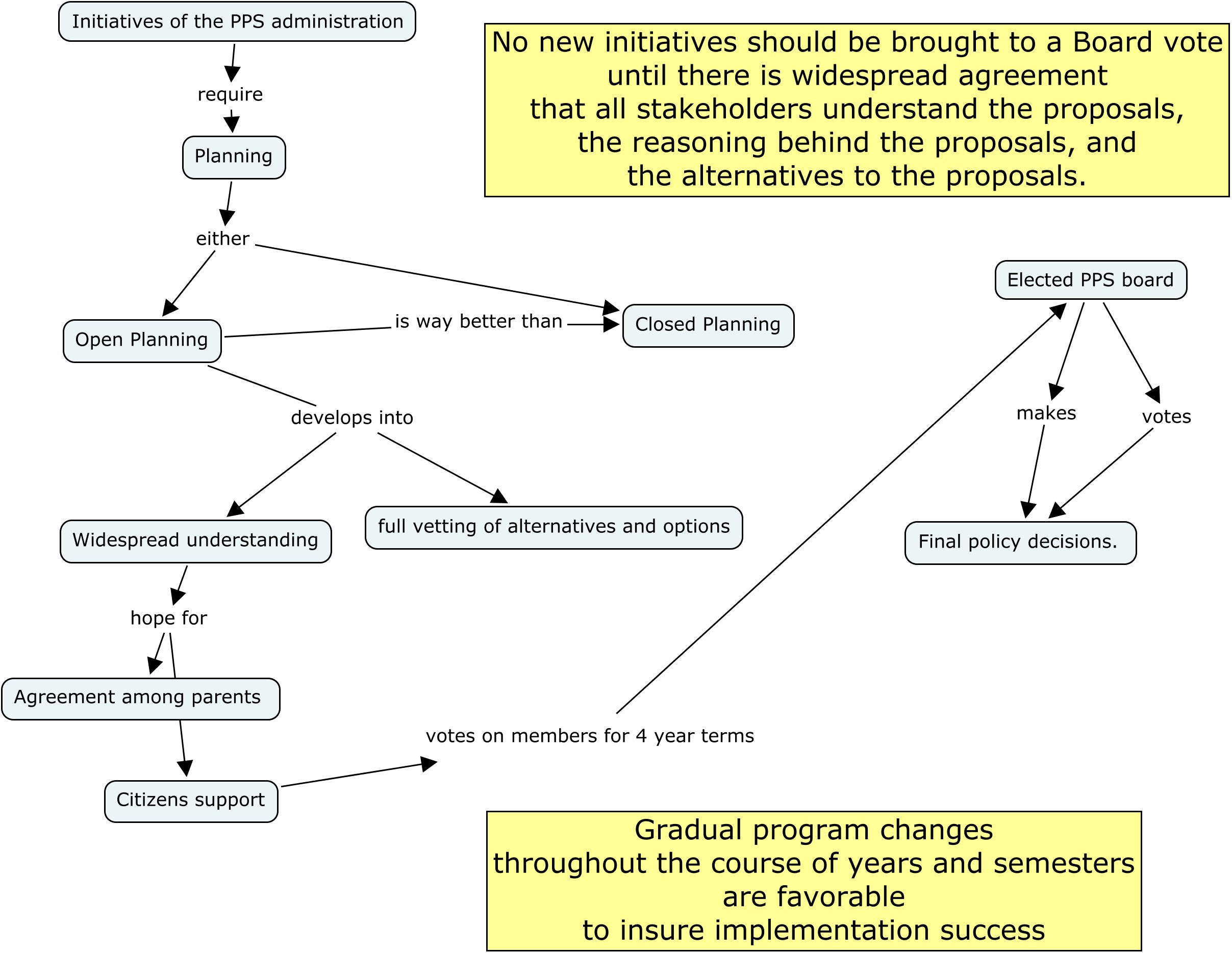
An older slide from lessons learned. What kind of advocate strategy are we going to aspire to? Real engagement or not?

Departing education secretary pleased with end-of-year exams, changes in curriculum
Departing education secretary pleased with end-of-year exams, changes in curriculum: "Dr. Zahorchak said, the remaining pre-kindergarten-through-grade-eight school in Duquesne, which he visited recently, has undergone a 'complete metamorphosis.'"Really.
Subscribe to:
Posts (Atom)

 Posts
Posts


