



Wednesday, February 18, 2026

Fwd: Weirdest realignment move yet?


Plus: Let's map new conference midpoints.
͏‌ ͏‌ ͏‌ ͏‌ ͏‌ ͏‌ ͏‌ ͏‌ ͏‌ ͏‌ ͏‌ ͏‌ ͏‌ ͏‌ ͏‌ ͏‌ ͏‌ ͏‌ ͏‌ ͏‌ ͏‌ ͏‌ ͏‌ ͏‌ ͏‌ ͏‌ ͏‌ ͏‌ ͏‌ ͏‌ ͏‌ ͏‌ ͏‌ ͏‌ ͏‌ ͏‌ ͏‌ ͏‌ ͏‌ ͏‌ ͏‌ ͏‌ ͏‌ ͏‌ ͏‌ ͏‌ ͏‌ ͏‌ ͏‌ ͏‌ ͏‌ ͏‌ ͏‌ ͏‌ ͏‌ ͏‌ ͏‌ ͏‌ ͏‌ ͏‌ ͏‌ ͏‌ ͏‌ ͏‌ ͏‌ ͏‌ ͏‌ ͏‌ ͏‌ ͏‌ ͏‌ ͏‌ ͏‌ ͏‌ ͏‌ ͏‌ ͏‌ ͏‌ ͏‌ ͏‌ ͏‌ ͏‌ ͏‌ ͏‌ ͏‌ ͏‌ ͏‌ ͏‌ ͏‌ ͏‌

Saturday, February 14, 2026

Why College Football’s Looming Collapse Endangers All Youth Sports and How to Prevent It


Coach Mark Rauterkus worries that the looming crisis in college football will create a ripple effects across all college sports. He outlines a reform plan, highlights recent program cuts, and offers a path forward.

You’ll learn in episode #89 of Heavy Or Not, The OG Swim Guide:

  • The urgent need to reform college football before it collapses and drags other sports down.

  • Key takeaways from Coach Nick Saban’s interview (Episode 88) and the reform package available at 4rs.org.

  • The fallout from Cal Baptist cutting its men’s Division I swimming & diving team and the disappearing full‑time diving coach.

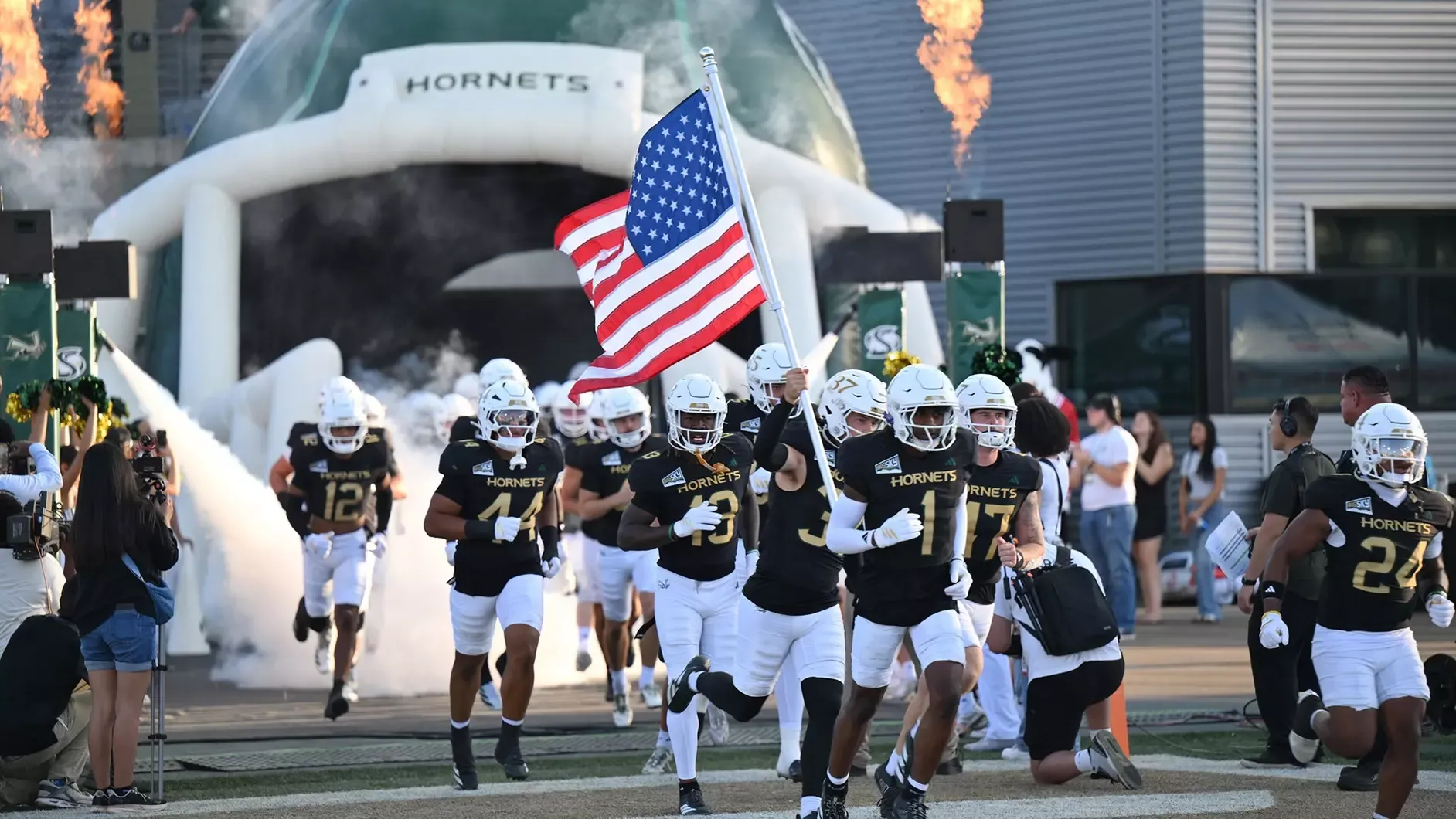
  • How a “pod” system with promotion/relegation could replace money‑driven conference moves (e.g., North Dakota, Sacramento State).

  • The risk of a 30‑team super league (“JV NFL”) and why equitable, merit‑based structures are essential for the sport’s future.

Let’s put equity over money. A New, Tiered Model to Preserve College Football’s Future needs your help.

Here is your call to action.

  1. Subscribe.

  2. Suggest.

  3. Comment.

  4. Share.

This Heavy Or Not podcast is pushing for a Merit‑Based, Pod System to Safeguard College Sports

  • Are you in?


Check out this episode!

Thursday, February 12, 2026

Nick Saban’s Five Enemies of Greatness via My New Best Friend at The 7 Minute Leadership Pod


How Entitlement, Discipline, and Complacency Undermine Teams – Insights From Saban

Inside Penn State’s Quarter‑Billion Dollar Athletic Budget and Its Profit Margins

In episode #88 of Heavy Or Not, The OG Swim Guide, you’ll meet my new best friend, Paul Falavolito and a snip from his show, The 7 Minute Leadership Podcast. He shares Nick Saban’s “Five Enemies of Greatness.”

Paul's Site, The 7 Minute Leadership Podcast

Plus, we’ll break down the money behind a powerhouse college athletic department. You’ll get practical leadership takeaways and a raw loo

k at Penn State’s finances.

  • The five hidden threats to performance: entitlement, lack of discipline, choosing circumstance over vision, self‑pity, and complacency.

  • How Saban’s “standards over hype” mindset translates to everyday leadership.

  • A step‑by‑step walkthrough of Penn State’s $254 M athletic budget – where the cash comes from and where it goes.

  • Why football alone generates 57% of the department’s revenue and the impact on other sports.

  • The razor‑thin profit margin and why college‑football reform (promotion/relegation, entry‑fee changes) matters now.

Outline

1. Podcast Introduction & Teasers

  • Host – Mark Rauterkus introduces his “new best friend” in podcasting, Paul Falavolito.

  • Mentions Paul’s own show “7 Minute Leadership.”

  • Announces upcoming content:

    • A deep‑dive with Nick Saban.

    • “A bunch of sports news in college swimming and college sports” that will appear in Episode 89.


2. Leadership Lesson: Nick Saban’s Five Enemies of Greatness (7 Minute Leadership)

a. Who Is Nick Saban?

  • Most successful modern‑sports leader; multiple national championships.

  • Built dominant programs at several schools over decades.

  • Known for selling standards, not hope – discipline, consistency, daily execution.

b. The Five Enemies (each broken down)

  • Entitlement

    • Success whispers “you deserve comfort.”

    • Leaders stop preparing, teams rely on reputation.

    • Rent‑based metaphor: respect, trust, results are “rented daily.”

  • Lack of Discipline

    • Doing the work when no one’s watching; showing up on time.

    • Small lapses (late meetings, cutting corners, ignoring safety steps).

    • Sloppy habits ⇒ sloppy outcomes.

  • Choosing Circumstances Over Vision

    • Letting conditions dictate effort.

    • Great leaders hold the line regardless of budget, morale, or external pressure.

    • Avoids “meteorocracy” (followers drifting with every change).

  • Self‑Pity

    • “No one appreciates us” mindset; excuses become the norm.

    • Kills ownership and responsibility.

    • Leads to rapid decline.

  • Complacency

    • Thinking you’ve “arrived” – winning becomes expected, effort drops.

    • Turns champions into former champions.

    • Blind spots, reduced hunger, maintenance mindset.

c. Overarching Takeaway

  • Enemies sneak in quietly, sound reasonable, and cause damage before they’re noticed.

  • Saban’s dynasties were built by refusing to tolerate these enemies.

  • Call‑to‑action: Which enemy are you allowing right now?


3. Coaching Reflection & Mental‑Skills Prompt (Fortune Segment)

  • Quote: “Coaches become more knowledgeable by immersing themselves patiently in the systematic teaching of the mental and emotional skills.”

  • Presented as a reflection prompt: apply to training, competition, coaching, or life beyond the pool.

  • Suggests writing about the insight to turn ideas into habits.

  • Source: Mental Skills for Young Athletes – John Hogg, PhD (link: swimisca.com).


4. Nick Saban on Player Development & NFL Draft Process

  • Development First: Emphasizes “development as a person, student, and player” over money.

  • Draft Call Statistics:

    • 35 early‑exit players → >1,000 calls from NFL teams.

    • No calls ask about freshman playing time; focus is on development into a player.

  • Character Over Athleticism:

    • Teams ask about character, fit, teammate qualities, leadership.

    • Trustworthiness and ability to represent the organization are paramount.

  • Advice: “Create value for yourself in all those areas.”


5. NIL (Name, Image, Likeness) Resources

  • Website & Email List: nil.cloh.org – a hub for NIL information and community.


6. Penn State Athletic Department Financial Deep Dive (Guy Moderator)

a. Revenue Overview – Where the ~$254 M Comes From

  • Donations: $64.5 M (pure donor power).

  • Media Rights: >$58 M (Big Ten TV contracts).

  • Ticket Sales: >$50 M (fan attendance).

  • Zero funding from university tuition, state taxes, or student fees.

b. Expense Overview – Where the Money Goes

  • Personnel (Salaries & Benefits): >$84 M – the single biggest expense.

  • Athlete‑Related Costs: ~$48 M total, broken into:

    • Scholarships / Athletic Aid: >$24 M.

    • NIL Payments: >$18 M.

    • Educational Awards: ~ $5 M.

  • Facilities & Operations: Significant portion (second‑largest bucket).

c. Football Program As the Financial Engine

  • Generates ≈$147 M in revenue – >4 × the combined revenue of all other men’s sports and >16 × women’s sports.

  • Accounts for 57 % of total department income.

d. Bottom‑Line Result & Sustainability Question

  • Total revenues vs. total expenses differ by only ≈$223 K – essentially a “rounding‑error” profit.

  • Highlights the razor‑thin margin model and raises the question: Is this breakeven structure sustainable as NIL and revenue‑sharing rules evolve?


7. College‑Football Reform Discussion

  • Call for Reform: Need a functional, sustainable college‑football system.

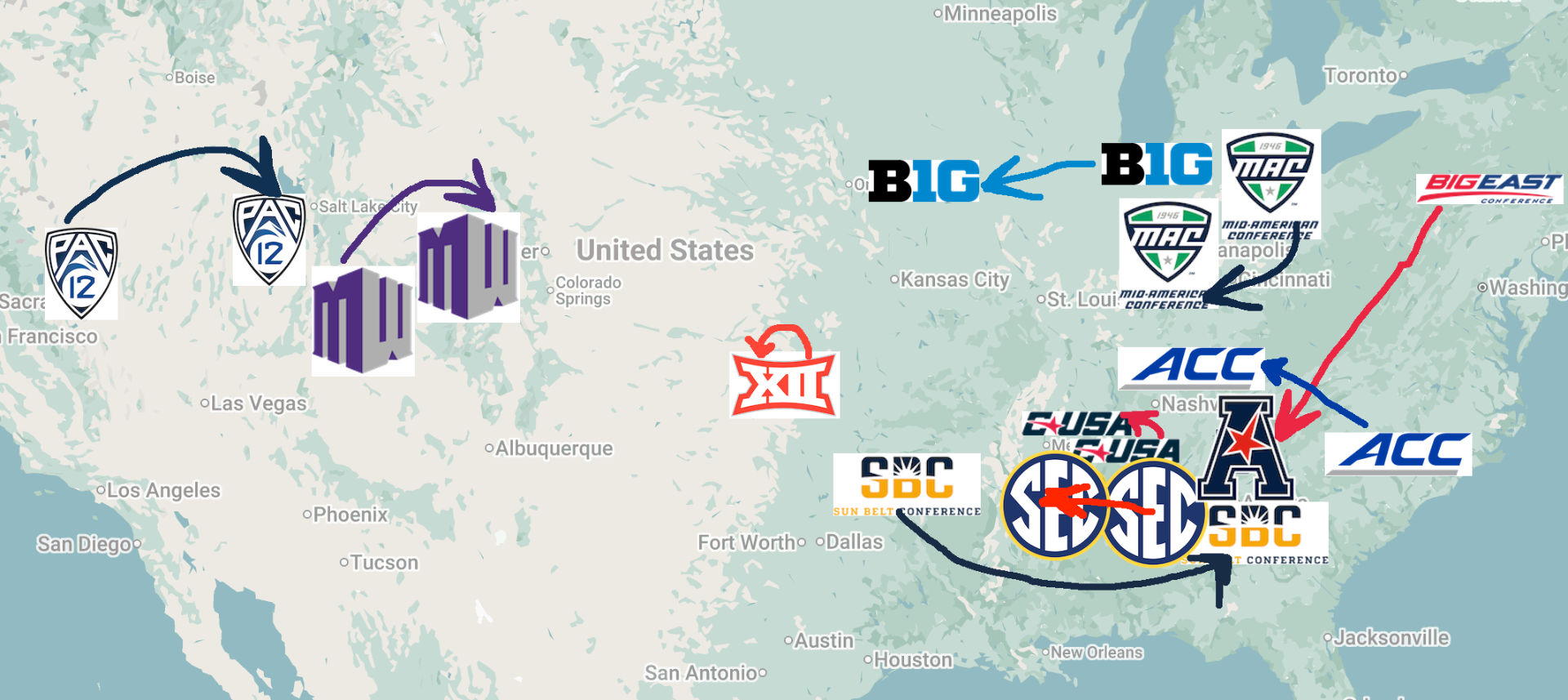
  • Geographic Remix of Conferences: Proposed plan (linked to Rauterkus.Substack and 4rs.org).

  • Promotion & Relegation: Suggests a system allowing movement between tiers, avoiding punitive $5 M entry fees for new programs.

  • New‑Program Examples:

    • North Dakota wanting “big‑time

      ” football (Paul’s comment).

    • Sacramento State—should not be penalized with heavy fees; discuss alternative handling.


Check out this episode!

Wednesday, February 11, 2026

Heavy or Not? The Doping Crisis No One Wants to Talk About | OG Swim Guide #90


Doping at 69?! The Ugly Truth About Recreational Sports. Say "No" to Enhanced Athletes and Their Games


Check out this episode!

Thursday, February 05, 2026

Point Park Chatbot

Point Park University launches AI chatbot to field admissions questions

More schools are using artificial intelligence chatbots to accommodate high schoolers’ schedules

For high schoolers, late-night hours are often an optimal time to research colleges and polish applications.

There lies an issue, though, for both teenage applicants and college admissions officials: After-hours questions go unanswered until staffers are back in the office.

That’s why more schools — including Point Park University in Downtown Pittsburgh — are introducing artificial intelligence chatbots to accommodate high schoolers’ schedules.

Point Park plans to roll out its 24/7 AI chatbot this week. In addition to offering greater convenience to students, it also will alleviate the workloads of admissions counselors, said Marlin Collingwood, the private school’s vice president of enrollment management.

 
Carnegie Mellon University is launching a new learning initiative called Learnvia, a nonprofit aimed at college students struggling to pass gateway courses. The Gates Foundation invested $55 million.
Chloe Jad
CMU launches AI-based learning initiative with $55 million from Gates Foundation

“It’s going to meet the demands that students and parents have, and free up our staff to review applications and talk to students,” Mr. Collingwood said.

Thanks to a partnership with Pittsburgh-based software company Skilly AI, prospective Point Park students will quickly get answers to their questions on the application process, program offerings, tuition and more, said Mr. Collingwood.

Currently, Point Park’s chat feature is manned by an admissions staffer who sits at a computer answering questions during an 8-hour shift. Nine in 10 questions can be answered by AI, Mr. Collingwood estimates.

After the rollout of the chatbot, if a student has a question that AI can’t answer, they’ll be redirected to a Point Park employee.

“We are using AI in ways that allow us to still have genuine relationships with prospective students,” Mr. Collingwood said. “We’re never going to look at AI as a way to replace real people. It’s going to help real people.”

Nationwide, other universities are also exploring ways to use AI to assuage the admissions process for themselves or their students. At Virginia Tech, an AI tool is reading 58,000 applicants’ essay questions alongside one human reader, vice provost for enrollment management Juan Espinoza told ABC News in January. It’s saved the admissions office thousands of hours of review.

Meanwhile, at California Institute of Technology, AI is interviewing students, with humans later reviewing the exchange, reported the Los Angeles Times last month.

 
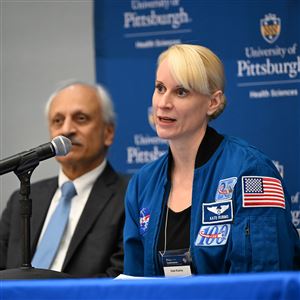
Retired NASA astronaut  Kate Rubins, director of the newly formed Trivedi Institute for Space and Global Biomedicine, speaks during a press conference at University of Pittsburgh in Oakland on Thursday, Jan. 29, 2026, part of the launch of the university’s $25 million Trivedi Institute for Space and Global Biomedicine Thursday.
Maddie Aiken
Pitt sets sights high with new institute for space, biomedicine

Admissions offices began using this technology about three years ago, said Michael Koppenheffer, vice president for marketing, innovation and AI strategy at Washington-based educational consulting firm EAB.

Initially, that use involved ground-up experimentation — individual counselors would implement ChatGPT to draft rejection letters or ask it to summarize general themes in essays to learn more about their applicant pools.

In the past year, though, efforts have taken a more top-down approach. A growing number of colleges are using AI to read transcripts, recalculate GPAs for standard equivalence and service chats, Mr. Koppenheffer said.

So far, AI implementation in admissions has been “moderate and somewhat cautious,” he noted.

“It's still not systematic, pervasive or particularly advanced,” Mr. Koppenheffer said. “It still feels very experimental and exploratory… I wouldn't say that it has been transformational yet.”

As more schools turn to AI, Mr. Koppenheffer noted that it cannot fully replace human tasks.

Counselors should be on the lookout for hiccups and inaccuracies in AI’s work, Mr. Koppenheffer said. He also cautioned admissions offices against replacing staffers with AI.

Higher education is an “extremely human experience and extremely human product,” he said.

“For something very important, like a decision about whether a student is going to get into a college or not, you don't want to give that over to AI,” he said. “AI can be helpful in specific parts of processes, but you really don't want to cut the human out of the loop.”

Looking ahead, Mr. Koppenheffer anticipates continued experimentation. Chatbots in particular could become very popular, he envisions.

“If you implement it right, [AI] is actually making things better for families, students and colleges,” Mr. Koppenheffer said. “I think we're going to see more of that, because it supports the mission of what admissions offices are all about.”

First Published: February 4, 2026, 12:00 p.m.
Updated: February 4, 2026, 12:57 p.m.